Ontologically, biologically, quintessentially, irreducibly, poison.
In her first appearance on the cover of Batman #181, the reader is warned “Beware of – Poison Ivy!”, while a text arrow, unsubtly pointing directly towards her crotch, teases if she is the cause of “Trouble between the dynamic duo [of Batman and Robin]!” (Kanigher 1966a, cover). The cover artwork by Carmine Infantino serves as a visual introduction to Poison Ivy, created by writer Robert Kanigher and artist Sheldon Moldoff, and the type of threat that she will come to pose. This first image of Ivy is of a red-headed, fair-skinned woman, dressed in verdant tights, corset, and crown, all covered in poison ivy plant leaves, somewhat like a tree-nymph but with a defiant stance and expression. For superheroes and their counterparts, “The costume is an intoxicating demonstration of personal and ideological confidence” (Brownie and Graydon 2016, 1); although her neckline can plunge, her fabrics can thin, and her body can foliate, Ivy’s intoxicating visual identity has remained comparable to this initial design and presentation over the years.
As with all superhero symbols, the shifting ways in which comic book images of Poison Ivy are deployed by writers and artists can be mapped over the fluctuating relationships between Ivy and her powers, and the ideologies that she subsequently extols and represents. The most significant visible change to Ivy over the years is in relation to her skin tone, with her epidermis transforming to shades of green during the Modern Age of comics as Ivy becomes more linked to the elemental properties of nature and The Green, oftentimes with chlorophyl for blood; then, as Ivy has more control over her powers, she has an increased autonomy over her visual representation within the diegesis, which parallels the greater sophistication with which her character is developed. Ivy always operates between the allegedly competing poles of nature and humanity within her character, and through her supervillain gimmicks, these positions, which are never entirely oppositional despite her ardent claims, become an overlapping and inextricable amalgamation of natural danger mixed with human sexuality.
Notably, where DC Comics character Alec Holland’s transformation into Swamp Thing could be viewed as a “trans-ing” of the comic text, which “signals a disruption to the organizing principles of sex, gender, and sexual morphology” (McDonald and Vena, 212-213), no such occurrence takes place with Poison Ivy, for equally purposeful reasons. Ivy’s criminal inclinations oscillate over time due to internal and external pressures, but within the first issue, the Queen of Crime (in later years, the Queen of Green) brazenly informs a gathered crowd, “Don’t forget to spell the name right, boys! Poison – as in Arsenic! Ivy – as in Irresistible!” (Kanigher 1966a, 3). By her second appearance, in Batman #183, Robin is encouraging Batman to take “deep breathes” to get “Poison Ivy out of [his] system” (Kanigher 1966b, 12). Through her own admission and subsequent actions, Poison Ivy is primarily presented as dangerous to men, their bodies, and their cultures, in more ways than one.
Poison Ivy has also changed in recent years to become Harley Quinn’s lover, a figure who has herself turned towards the role of the anti-hero, and has enabled Ivy “to drop her guard and enjoy herself once in a while”, but as The DC Book of Pride goes on to make clear, being gay does not make her more peaceable as “Ivy has redoubled her efforts to destroy anyone who dares to damage the environment” (Axelrod 2023, 87). Of the few titles to directly consider Batman’s criminal cohort, the matchbox-sized gift-book Villains of Gotham City offers a more direct, gender-focused summation of her contemporary character: “Poison Ivy sees herself not as a super-villain but as nature’s great defender against the evils of man” (Avila 2020, 92). Similarly, in regards to being called Poison Ivy, in Secret Origins: Starring Green Lantern and Poison Ivy #36 an agent of Task Force X asks her “Why that name? Why not a flower? Why a weed?”, to which this version responds “A weed is just a plant some human decides is growing in the wrong place” (Gaiman 1989, 41). Across all of her forms, Ivy disrupts the systems that define and position women, or “weeds”, like her. Modern Ivy has been described as “a militant mother in the ecofeminist movement” (Knopf 2023, 202), and while this faltering villain to anti-hero trajectory may appeal to readers, as demonstrated by an increase in Poison Ivy related appearances in comics and other media, Ivy’s so-called feminine and criminal wiles have always been one and the same to Batman who sees her as perpetually and irrevocably poisonous throughout her entire publication history.
One Poison Ivy cultivar offers her own subjective affirmation of what she represents. In the one-shot comic Batman & Poison Ivy: Cast Shadows, written by Ann Nocenti, while discussing her therapy sessions with Batman, Poison Ivy refers to the self-fulfilling conventions of comic books: “It’s absurd – The Joker is a Joker! Two-Face is Two-Faced! And I’m Poison! Ontologically, biologically, quintessentially, irreducibly, poison” (Nocenti 2004, 45). Yet, while the Ivy of this narrative considers herself to be irredeemably toxic, this is also the same story in which the only cure for a contagious disease (not created by Ivy, but a male admirer of hers) is “a kiss from the lips of an escaped asylum psychotic”, this being Poison Ivy (Nocenti 2004, 36). Even when she is not being consciously villainous or seductive, Ivy’s body becomes a site of negotiated contention to be sought and used by men, all in a sexualized relationship poured through the funnel of poison. Within Cast Shadows, an exasperated Batman compares Ivy to a snake that contains its own anti-venom, but elsewhere in the comic, while Ivy is explaining to Batman that much like the poison/antidote analogy from nature there is a self-perpetuating cycle of heroic and criminal acts in their world, he bluntly offers “I don’t have time for loaded metaphors” (Nocenti 2004, 30). Of course, the joke is that Batman is a heavily loaded metaphor, certainly as much as someone called Poison Ivy, and in this example, as across several of their encounters, Batman is shown to be ‘poisoned’ by his own assumptions of Ivy.
Poison Ivy is rendered in different ways across multiple, often simultaneous and conflicting, texts, and while this chapter will be limited in scope to mostly discussions of her comic book appearances, it will examine how the representation of Poison Ivy, as a type of poisonous/poisoned figure that embodies a conjugation of human sexuality and environmental horror, has been developed, articulated, and moderated throughout her publication history. The first section will explore how, mainly through her appearances on cover art, Ivy’s visual identity has been used as a negotiated site, which leads towards varying outcomes derived directly from the contrasting commercial demands placed directly upon her objectified body. The second section will seek to understand how Ivy has been shaped within the texts themselves, and will show how her attributes (powers/intelligence) and key narrative drivers (the environment/origin stories) may evolve and expand, and often reshape in scope and execution, but that there is a rotten, fundamental thematic bedrock from which she is always grown poisonous, as a woman subject to the pressures of oppressive external control…
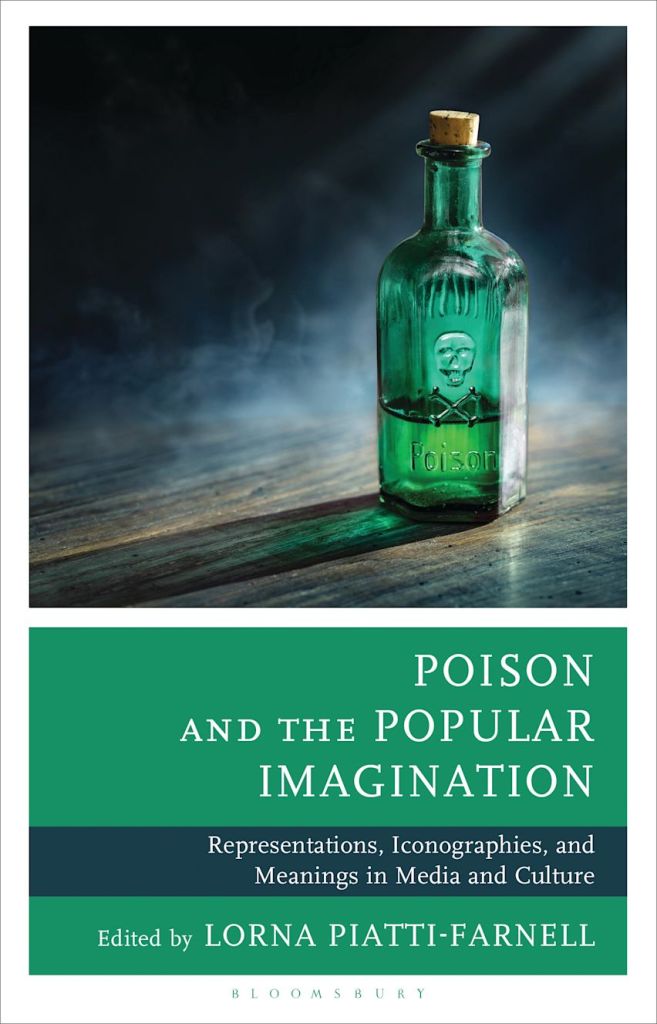
The full 7,000 word version of this chapter is published in Poison and the Popular Imagination, edited by Lorna Piatti-Farnell, published Bloomsbury Academic, 2026.
 Carl Wilson